The Trivandrum Metro is a major public transport initiative aimed at transforming mobility in Kerala’s capital city. Upgraded from a Light Metro to a conventional elevated metro system in late 2025, the project is designed to handle long-term traffic growth while offering faster, more reliable travel across key parts of the city. As of January 2026, the project has reached an important execution-ready stage, with groundwork and planning activities already in motion.
What is the current status of the Trivandrum Metro project?
The project has received final in-principle approval from the Kerala State Government, with the Phase 1 route officially finalised in November 2025. Preparatory works have already begun on the ground, and central government approval is expected within the first half of 2026. Once this final clearance is received, full-scale metro construction will proceed without delay.
To ensure smooth implementation, flyover construction is underway at key junctions such as Sreekaryam, Ulloor, and Pattom. These flyovers are being designed to accommodate future metro pillars, allowing metro infrastructure to be integrated seamlessly into the city’s road network. After complete approvals, the metro system is expected to be ready within approximately 30 months.
Phase 1 Route and Key Stations
Phase 1 of the Trivandrum Metro will span 31 kilometres and include 27 stations, connecting some of the city’s most important activity zones.
Technical Features and Cost Details
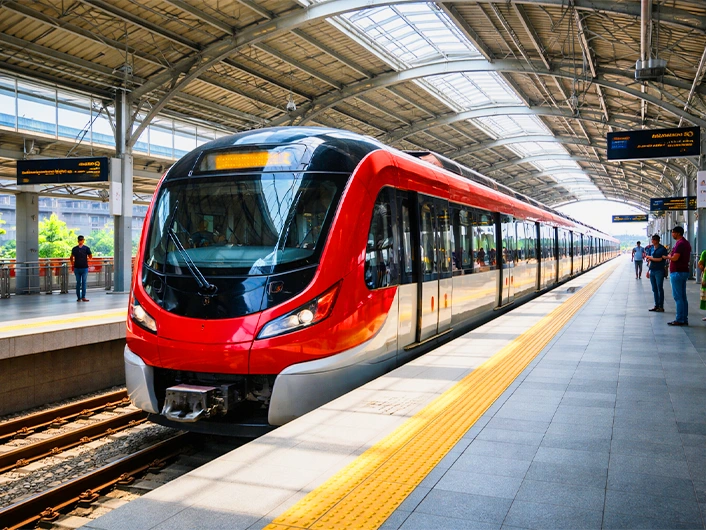
The Trivandrum Metro will operate as an elevated conventional metro system using modern three-coach trains, offering safe, efficient, and comfortable travel.
The fare structure is planned to remain affordable, supporting daily commuters as well as occasional users.
Where will the metro trains be maintained and operated from?
The main metro depot and maintenance facility for Phase 1 is proposed at Kariavattom, on land belonging to the University of Kerala. This depot will house train stabling lines, maintenance workshops, and operational control facilities, forming the backbone of the metro system’s daily operations.
In parallel, a detailed technical survey by the Delhi Metro Rail Corporation (DMRC) is underway to finalise land requirements and optimise the alignment. This ensures that metro infrastructure, flyovers, and stations are planned together, resulting in a well-coordinated and efficient urban transport system.
Funding and Completion Outlook
Phase 1 of the Trivandrum Metro will follow a balanced funding model:
Once final approvals are secured, officials expect the project to be completed within 30 months, bringing modern rapid transit services to the city.
The Road Ahead for Trivandrum Metro
The Trivandrum Metro is set to become a cornerstone of the city’s future development. By linking residential areas, employment hubs, transport terminals, and public institutions, it will significantly improve daily commuting while supporting sustainable and planned urban growth.
FAQs
1. When is the Trivandrum Metro expected to begin full construction?
Full construction is expected to begin after central government approval, anticipated in the first half of 2026.
2. How long will Phase 1 of the metro take to complete?
Phase 1 is expected to be completed within approximately 30 months after final clearance.
3. What is the total length of Phase 1?
Phase 1 will cover 31 kilometres with 27 stations.
4. Which areas will benefit most from the metro?
Key areas include Technopark, Medical College, Secretariat, major railway and bus stations, and the International Airport.
5. Who is implementing the Trivandrum Metro project?
The project is being implemented by Kochi Metro Rail Limited (KMRL).
6. Will the metro be affordable for daily commuters?
Yes, proposed fares range from ₹11 to ₹42, depending on travel distance.